
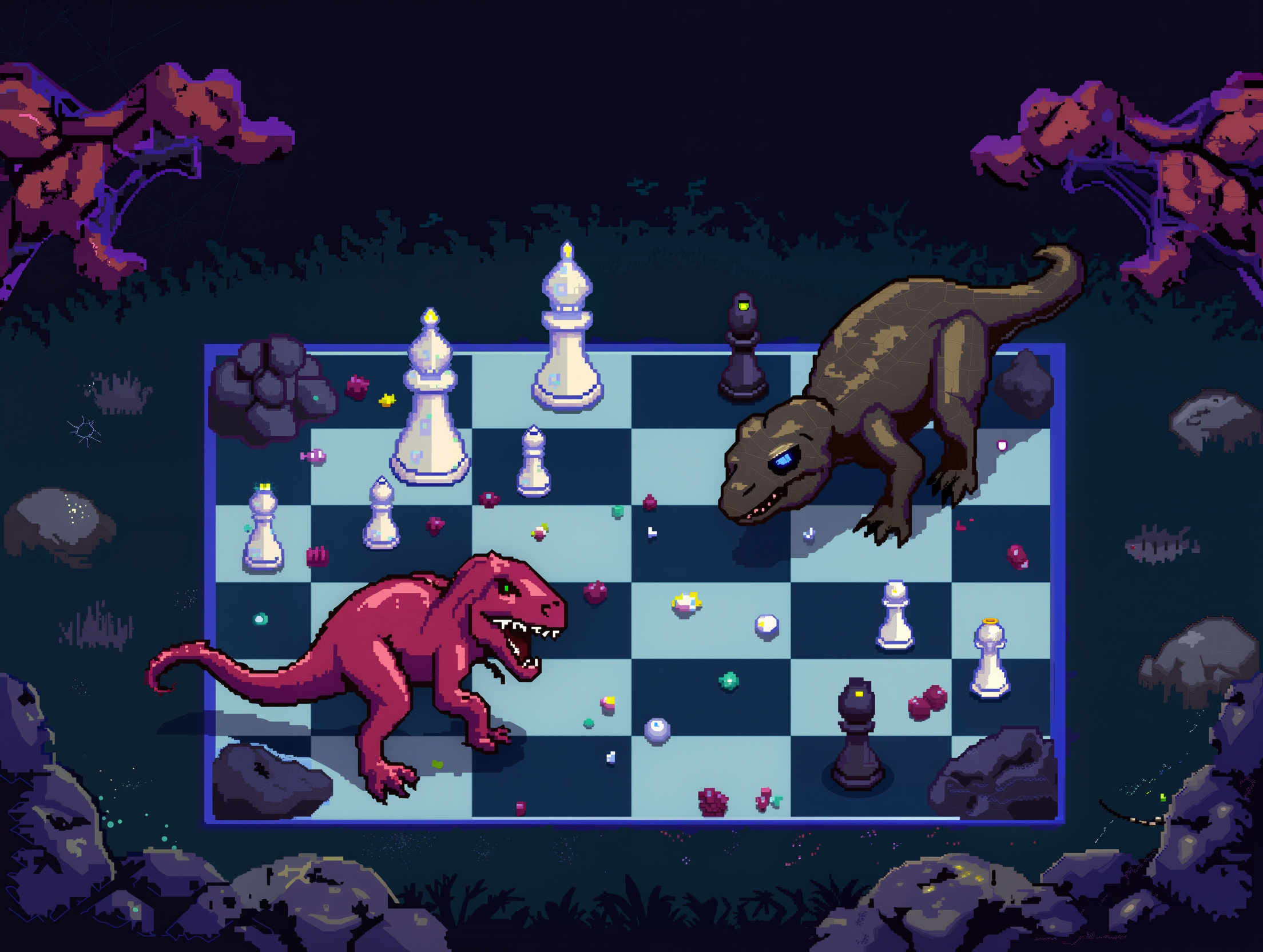
Why Every Move Matters in Exaverse
Many mobile games reward fast tapping. Exaverse rewards knowing where to move next.
You control Pax, an evolved dinosaur fighting AI robots across short dungeon stages. Moving toward a GEM, entering an enemy’s range, or activating a powerup can change the entire encounter.
The controls are simple, but the strategy comes from reading the map and anticipating how each robot will respond.
For a broader overview of the full gameplay loop, read How to Play Exaverse.
A Dinosaur Game Built Around Positioning
Each Exaverse stage presents a series of small tactical decisions:
- Do you mine the nearby GEM or move away from an approaching robot?
- Do you attack now or reposition for a safer angle?
- Do you use a powerup or save it for the next encounter?
- Do you enter the portal or keep exploring for more resources?
Pax moves through the dungeon one tile at a time. Once an action is committed, enemies follow their own movement and attack patterns.
This makes positioning just as important as damage. The strongest option is not always attacking first. Sometimes the better move is creating distance, drawing a robot into danger, or saving a powerup until several enemies are in range.
TAP and SWIPE Controls
Exaverse offers two control styles without changing the underlying gameplay.
TAP Controls
TAP mode uses directional arrows. Each tap moves Pax one tile or performs an action in that direction, such as attacking, mining a GEM, or interacting with an object.
This mode is faster and more precise, making it useful when several threats are close together.
SWIPE Controls
SWIPE mode allows you to swipe and hold anywhere on the screen to move continuously. Movement still occurs one tile at a time.
Mining, attacking, using powerups, and activating consumables are handled with taps.
SWIPE is designed for relaxed one-handed play, while TAP offers greater control over individual movements. Players can choose the style that feels best for each situation.
Robot Enemies Follow Different Rules
Tactical movement matters because every robot behaves differently. Learning those behaviors allows you to predict danger instead of simply reacting to it.
Assault Robot
Assault Robots move toward Pax one tile at a time and attack at close range.
They are straightforward alone, but several Assault Robots can restrict movement and trap Pax between different threats.
Scout Robot
Scouts can move up to two tiles, allowing them to close distance faster than other robots. Their first attack can begin from farther away before they land next to Pax.
Scouts may also emerge when Pax moves through tall grass. A route that appears empty can quickly become dangerous.
Mining Robot
Mining Robots prioritize collecting a GEM before attacking Pax.
Once a Mining Robot gathers one GEM, it switches its attention to the player. This creates a different type of pressure because ignoring it may cost you a resource needed to reach the portal.
Understanding these patterns turns each stage into a tactical puzzle. You are not only asking whether Pax can attack a robot. You are asking what that robot will do next.
Powerups Change the Battlefield
Pax’s three powerups provide different answers to dangerous positions.
- RAZOR CLAW deals high damage to one target. It is useful for removing a priority enemy before it can act.
- STAMPEDE attacks multiple targets. It becomes valuable when robots gather around Pax or block several routes.
- SHIELD protects Pax from incoming damage, allowing you to survive a risky position or prepare a counterattack.
Powerup timing matters as much as the ability itself. Using RAZOR CLAW on a weak robot may leave you without it when a Scout appears. Activating STAMPEDE too early can waste its multi-target advantage.
Boons can further modify these abilities with lightning, repeat attacks, additional targets, and defensive effects. Read Exaverse Boons, Powerups and Consumables Explained to see how these systems work together.
Using GEMS Without Losing Position
GEMS are required to activate the exit portal, but mining one requires Pax to commit to its position.
Before moving toward a GEM, consider:
- Which robots can reach that tile?
- Will mining give a Scout time to close the distance?
- Is a Mining Robot moving toward the same resource?
- Is there a safe route back to the portal?
Once the portal opens, you can leave the stage or continue exploring. Staying may produce more resources and powerups, but it also creates more opportunities for the run to go wrong.
That choice between safety and reward is one of the central decisions in Exaverse.
Jungle Traps and Hidden Threats
Season 1 takes place in the Jungle, where the environment adds another layer to movement.
Plant traps can punish careless routes, while tall grass may hide an incoming Scout. Certain Jungle boons can turn plant traps against robot enemies, creating strategies built around positioning rather than direct attacks.
This makes the safest route depend on your current build. A trap may be something to avoid during one run and a useful weapon during another.
Explore current strategies in the best Exaverse builds for Pax.
The Fight Against Amethyron
Stage 10 ends with Amethyron, Warden of the Wild.
Amethyron uses warned attacks that give players time to move away from threatened tiles. As the fight progresses, the boss teleports to new positions and summons Assault Robots.
The encounter tests several skills learned during the run:
- Reading attack warnings
- Maintaining a safe route
- Managing groups of robots
- Timing RAZOR CLAW, STAMPEDE, and SHIELD
- Repositioning when the battlefield changes
Saving the right powerup can be more valuable than entering the fight with the highest possible damage.
Why Tactical Movement Works on Mobile
Exaverse is built for vertical, one-handed play on iOS and Android.
Individual actions are easy to understand, but the interaction between movement, robots, GEMS, hazards, and powerups creates depth. Early stages can be completed quickly, while a full biome run provides a longer tactical challenge.
Core gameplay is also designed to work offline, making it suitable for short sessions wherever you play.
Learn more about the playable dinosaur at the center of the game in Meet Pax: Exaverse’s Parasaurolophus-Inspired Hero.
Tips for Better Movement
- Check how far each robot can move before entering its range.
- Be especially careful around Scouts and tall grass.
- Intercept Mining Robots when you need the GEM they are targeting.
- Use RAZOR CLAW against priority targets and STAMPEDE against groups.
- Treat SHIELD as a positioning tool, not only emergency protection.
- Open the portal before taking unnecessary risks for extra resources.
Frequently Asked Questions
Is Exaverse a turn-based game?
Exaverse uses action-by-action tactical movement. Robots respond according to their behavior as Pax moves and acts, but the game is designed to feel quick and natural on mobile.
Can you use swipe controls without losing the tactical gameplay?
Yes. SWIPE movement still advances one tile at a time. It changes how movement is entered, not how enemies or dungeon rules work.
Do all robots move at the same speed?
No. Assault and Mining Robots move one tile at a time, while Scouts can move up to two tiles and close distance more quickly.
Can you play as a dinosaur?
Yes. Players directly control evolved dinosaur heroes called Exadons. Pax, the first playable character, is inspired by Parasaurolophus.
Make Your Next Move
Exaverse combines simple mobile controls with tactical movement, distinct enemy patterns, and playable dinosaur heroes.
Try Exaverse’s tactical mobile gameplay in Early Access and help Pax fight back against the machines.